Visar inlägg med etikett Action. Visa alla inlägg

lördag 13 februari 2016

Hot Off The Presses: Deadpool (2016) Review

So, I just got back from the theatre. While I prefer to do more in-depth reviews and reflect on a film for some time before reviewing it, I thought it would be fun to share my initial thoughts on this particular film. Why? Well, this is a film that demands to be talked about. Not because it's ground-breaking, which it isn't, but because it is, in my opinion, extremely well-made. And fun. It's really fun. Because I sincerely think you should see it, this review will be spoiler-free.

Deadpool (Tim Miller, 2016) is a black comedy-superhero-action film about Wade Wilson (Ryan Reynolds), a former special ops operative, now a thug for hire, who is subjected to horrible experiments, giving him superpowers but deforming him in the process. He becomes the masked vigilante Deadpool and embarks on a quest for revenge and to get his girl back.


As you can see from the trailer, there is more to this film than the basic story. The film is based on the Marvel Comics character of the same name and is set in the same universe as the X-Men film series. While I haven't read any Deadpool comics myself, I do have an idea of who the character is. Known as the "Merc with a mouth", he is an insane, witty antihero mercenary with a tendency to break the fourth wall. In other words, he is aware that he is a comic book character.

How does this character then translate into film? I'm going to break this review down into three parts, each focusing on how the film works as comedy, superhero and action film separately, before finishing with some concluding thoughts.

Comedy
You will laugh. The film is constantly throwing jokes, of varying quality, at you and you will laugh throughout most of it. Some jokes are vulgar, some are childish, some will be completely lost on you if you aren't up to date on pop culture trivia. Some are clever and set up and executed extremely well. These, along with how much fun Ryan Reynolds seems to have portraying the character, will help you cope with jokes of lesser quality. If you see the film with subtitles, you'll also laugh at the feeble attempts of the translators to interpret Deadpool's inventive insults to a non-english speaking audience. However, one thing that bothered me a bit is that the film is riddled with pop culture references. Some, especially those related to other superhero films, are brilliant, but a lot of them just makes you think of Family Guy (1999-).

Anyone familiar with Ryan Reynolds body of work knows that he is a great comedic actor, which is incredibly important in this film. Deadpool is not only the film's protagonist and narrator, he is the focus of nearly every scene. And Reynolds definitely does a good job. He is, however, not the only funny actor in the film. Morena Baccarin, of Firefly (2002) fame, who plays the love interest Vanessa and T. J. Miller, who plays Deadpool's best friend Weasel, both get funny lines and scenes. However, they do come up short compared to Reynolds.

Superhero film
Is Deadpool even a superhero film? Deadpool is an antihero, who in the film explicitly rejects the superhero label. He also doesn't save the world, as is typically the case in superhero films. He does however have a villain to defeat and an underdeveloped love interest to save. He also seems to be aware that he is in a superhero film. This type of fourth wall-breaking self-awareness is, as far as I understand, very typical of his comic book counterpart and, as mentioned above, it does open up a lot of comedic possibilities. In one scene, he visits Charles Xavier's School for Gifted Youngsters and comments on that it is almost empty because the producers couldn't afford to have more than two X-Men in the film. He also makes fun of other superhero films, particularly X-Men Origins: Wolverine (Gavin Hood, 2009), where Reynolds portrayed a much-hated version of Deadpool.

Is Deadpool then a subversion or a parody of the superhero film genre? I wouldn't go that far. To call it a subversion would be to ignore how much it borrows from other superhero films in terms of plot structure and scenes. There is, for example, a scene where a deformed pre-Deadpool Wade Wilson walks down the street with a hoodie, trying to hide his deformed face, reminiscent of a scene with Ben Grimm/The Thing (Michael Chiklis) from Fantastic Four (Tim Story, 2005). To call it a parody would be insulting. The best comparison I can make is to Edgar Wright's "Cornetto trilogy" - Shaun of the Dead (2004), Hot Fuzz (2007) and The World's End (2013) - which are not really parodies of zombie, action and science fiction films, but are comedies set in those kinds of genre film universes. This is probably the best way to view Deadpool.

Action
Why do we watch action films? To get excited, get our blood pumping and just say "whoa" at how magnificent fights, car chases, and destruction of property can be. And Deadpool delivers. Its action scenes are well-made, albeit not particularly innovative, and the fight choreography is brilliant. Deadpool fight with guns, swords and martial arts and does some very impressive jumps and flips.

There is, however, another important part of any action film that is arguably missing in Deadpool: the sense of danger. This is for a number of reasons. Firstly, Deadpool's skills and superpowers make him almost indestructible and we never really fear for his life. Contrary to this, one could argue that the film still has high stakes. Deadpool has to save his love interest and defeat the villain, who is a very threatening character. Ed Skrein gives a quite scary performance when his character is the one in control of the situation.

Secondly, the film is sometimes a bit too self-aware and breaks the cinematic illusion, which reminds us that we are indeed watching a film. Some action scenes even stop for a second for Deadpool to deliver a one-liner. This was something that I was worried about early in the film - how can we empathise with a character that doesn't appear to take anything seriously? While this was a bit of problem throughout the film, there are scenes that show us that there is a real person behind the red mask and the jokes.

Concluding thoughts
Deadpool is, despite the problems mentioned above, a really good film. It somehow manages to be both dark and light-hearted at the same time - don't ask me how. If you're a fan of superhero films, you should go see it now.

onsdag 27 maj 2015

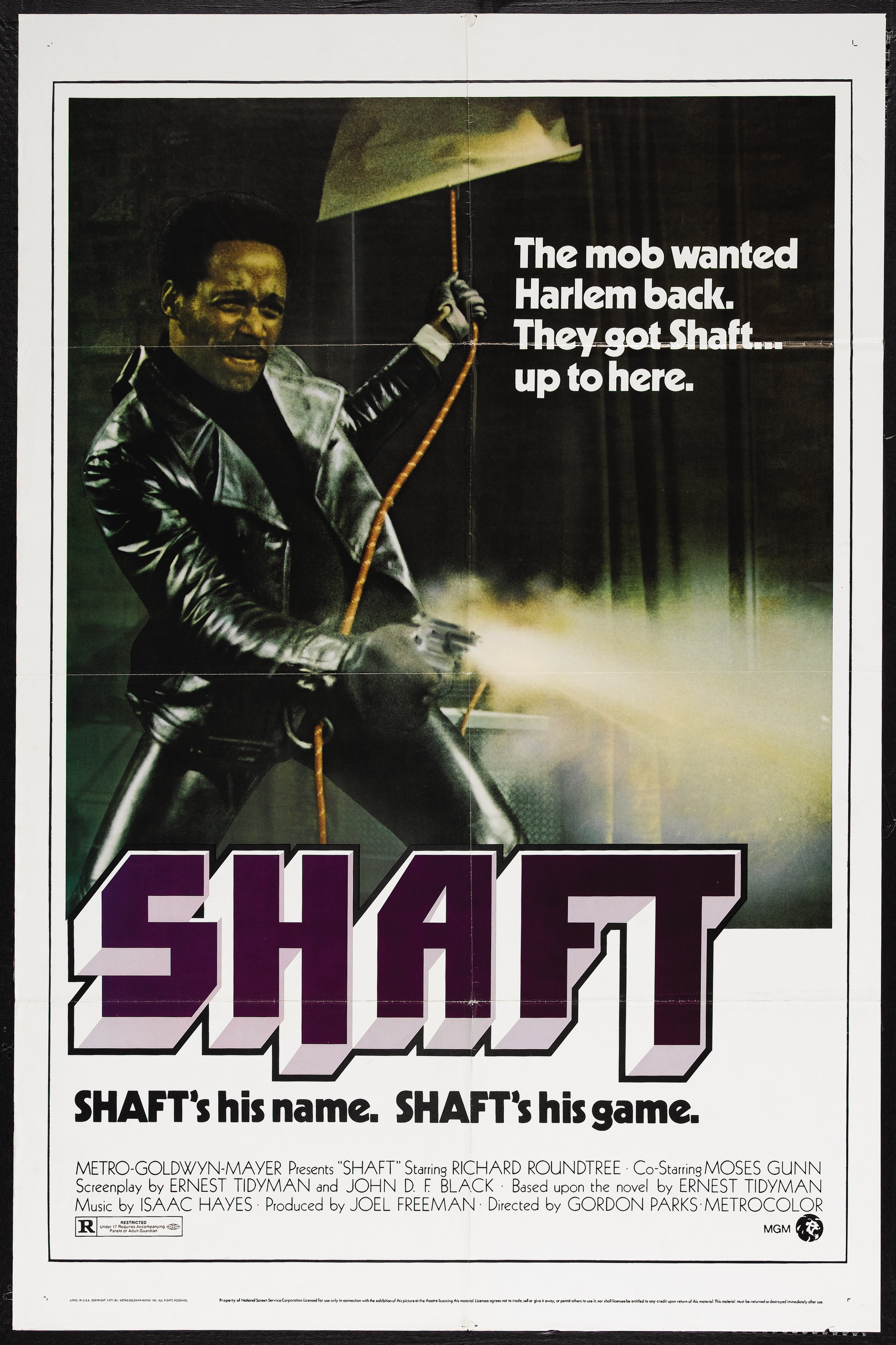
Shaft (1971) and Shaft (2000): A Comparison

While I usually deal with horror films, today I will discuss something more terrifying: racism. Or, at least, two films with African American leads that deal with race. Admittedly, there are plenty of classic films about racism, such as To Kill A Mockingbird (Robert Mulligan, 1962), I could have chosen, but the two films I will discuss today are, to be honest, more entertaining and tie in to an interesting subgenre of exploitation: blaxploitation.

Blaxploitation refers to a subgenre that emerged in the 1970s , catering to a black urban audience and featuring mostly black actors, often in stereotypical roles, soul music and themes relevant to African Americans. I must admit that I am not particularly well-versed in the subgenre; other than today's films, I have only seen Jackie Brown (Quentin Tarantino, 1997), which is a spoof/tribute to blaxploitation.


Shaft (Gordon Parks, 1971) is a film about private detective John Shaft (Richard Roundtree), who is hired by black gangster Bumpy Jonas (Moses Gunn) to locate his kidnapped daughter. He later learns that the kidnapping is part of a larger conflict between black gangsters and the Italian mafia. Central to the story is Shaft's reluctance to work with the police who are aware that something is going on, as he and other blacks do not trust law enforcement.


Shaft (John Singleton, 2000) is not a remake of the 1971 film, but a sequel (there were two other sequels in 1972 and 1973 that I have not yet watched). John Shaft II (Samuel L. Jackson) is the original Shaft's nephew and a detective with the NYPD. He is working on a hate crime case, where rich playboy Walter Wade Jr (Christian Bale) is accused of killing Trey Howard (Mekhi Phifer), a young black man who embarrassed him at a nightclub after making racist jokes. The New York City black community is outraged after Wade, because of his father's connections, manages to get bail and escape the country before trial. Shaft arrests him two years later when he returns, but he is once again released on bail. This causes Shaft to angrily quit his job and he attempts to find a missing witness. Wade also wants to find the witness and hires Dominican gangster Peoples Hernandez (Jeffrey Wright) to locate and kill her. Richard Roundtree returns as John Shaft I and tries to persuade his nephew to work with him.


If you are interested, here are the trailers:


There are some things that one needs to take into account when comparing the two films. The 1971 film is blaxploitation, while the 2000 film is not. The latter does not feature the classic subgenre stereotypes (other than the black stereotype that Jackson somehow always seems to be playing). It is also worth noting that the 2000 film features significantly fewer black actors than the 1971 film. Finally, the difference in budget alone ($ 500,000 and $ 46 million) could force one to conclude that they cannot be fairly compared to one another, at least with reference to quality. Therefore, I will focus on story, characters and themes - aspects of a film that should not be too dependent on budget.

There are some other genre differences between the films. The 1971 film is a thriller, while the 2000 film is more action-oriented. Roundtree's Shaft is a lot less serious and more joking than Jackson's and his character is also heavily played up as a ladies' man. Jackson's humor comes more from what he does than what he says, even though he gets some funny lines. In one scene, in order to get Hernandez' attention, he throws a basketball at him through an open window. I guess you could say that Jackson is playing a typical Samuel L. Jackson character. That being said, I think it's a good thing that the two Shafts are very distinct characters and not just the same character at different ages.

In the 1971 film, issues of race are mostly visible in the idea that blacks cannot trust whites and a large emphasis on the black community. Bumpy Jonas knows that the police would be more interested in his illegal activities than his missing daughter and therefore has to approach Shaft, a man he respects but does not like very much. One reason Shaft, and other blacks, are willing to help him is because his daughter is black. Racial tensions are also shown through language and attitudes between Shaft and white characters.

In the 2000 film, race is mainly a factor in Wade's hate crime. Wade is a rich, white, young man who reacts so strongly to a black man in his favorite night club that he taunts Howard and later lethally assaults him after Howard non-violently, and comically (he cuts two holes in a white napkin and places it on Wade's head as to look like a KKK hood), stands up for himself. During every scene at the courthouse, a large group of blacks are seen angered by the crime and how Wade seems to be able to buy his way out of responsibility.

In my book, one of the most important things about an action or thriller film is the antagonist. The hero, or antihero, needs a worthy villain to really show the audience what he/she can do. This is unfortunately an area where the 1971 film is lacking. The Italian mafia is represented only by a few mobsters, none of whom we get to know that much about. The entire film is shown through Shaft's perspective and he does not actually learn too much about the mafia. On the other hand, the 2000 film gives us two well-defined antagonists. Wade is given a lot of screen time without Shaft and the antagonism between Hernandez and Shaft is set up really well. We also, for example, learn that Hernandez wishes to be like Wade: rich, famous and able to go to whichever club he wants. The villains, along with the hate crime narrative, is why I personally prefer the 2000 film before the 1971 film. Needless to say, they are both good films that you should check out if you haven't already.

Concluding this review, I would like to end with the awesome theme song from the 1971 film, less awesomely titled "Theme from Shaft", written and recorded by Isaac Hayes. It won numerous awards, including the Academy Award for Best Original Song. The lyrics might be a bit cheesy, but it fits the film perfectly.