Visar inlägg med etikett Thriller. Visa alla inlägg

onsdag 27 maj 2015

Shaft (1971) and Shaft (2000): A Comparison

While I usually deal with horror films, today I will discuss something more terrifying: racism. Or, at least, two films with African American leads that deal with race. Admittedly, there are plenty of classic films about racism, such as To Kill A Mockingbird (Robert Mulligan, 1962), I could have chosen, but the two films I will discuss today are, to be honest, more entertaining and tie in to an interesting subgenre of exploitation: blaxploitation.

Blaxploitation refers to a subgenre that emerged in the 1970s , catering to a black urban audience and featuring mostly black actors, often in stereotypical roles, soul music and themes relevant to African Americans. I must admit that I am not particularly well-versed in the subgenre; other than today's films, I have only seen Jackie Brown (Quentin Tarantino, 1997), which is a spoof/tribute to blaxploitation.
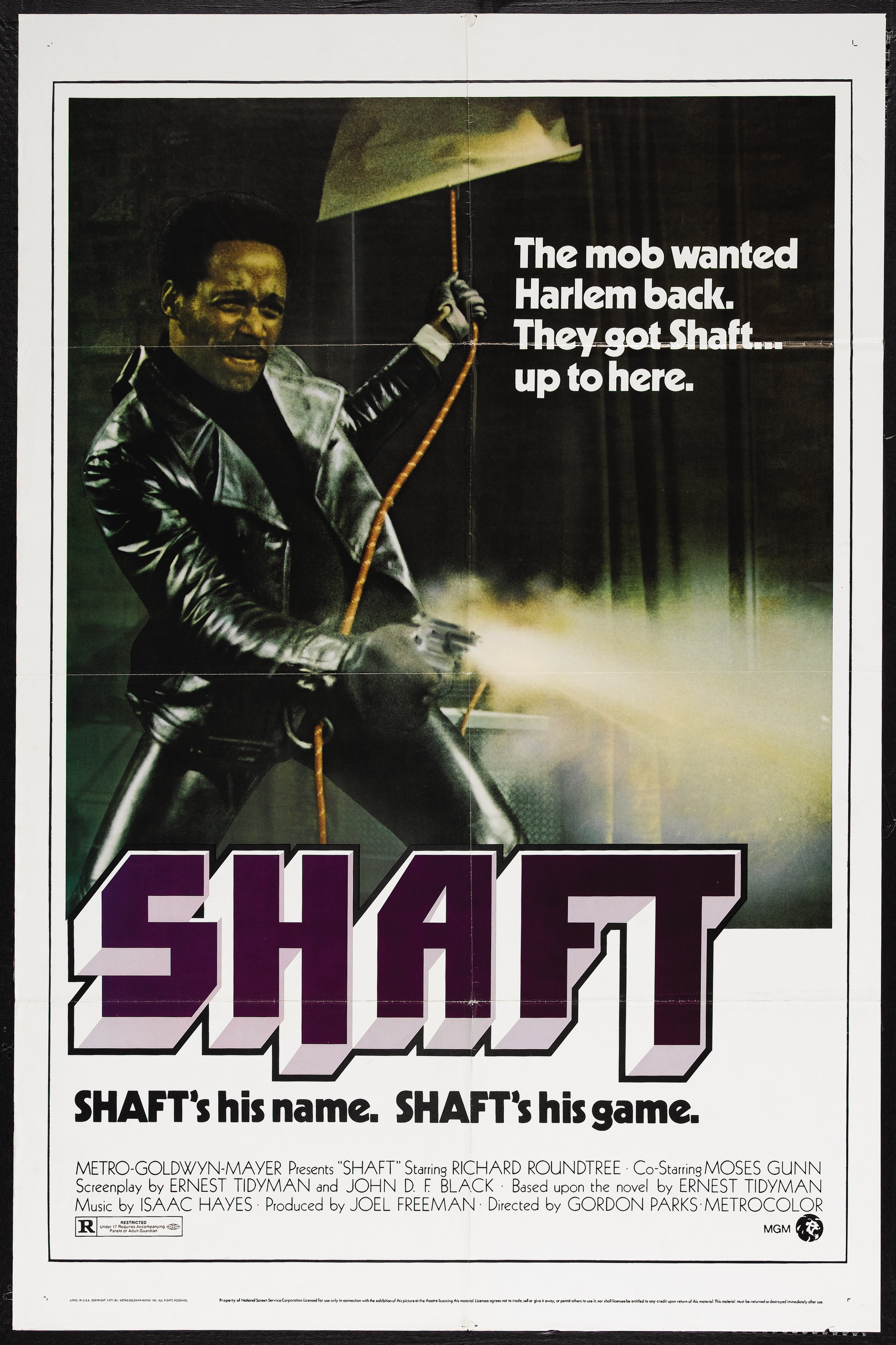

Shaft (Gordon Parks, 1971) is a film about private detective John Shaft (Richard Roundtree), who is hired by black gangster Bumpy Jonas (Moses Gunn) to locate his kidnapped daughter. He later learns that the kidnapping is part of a larger conflict between black gangsters and the Italian mafia. Central to the story is Shaft's reluctance to work with the police who are aware that something is going on, as he and other blacks do not trust law enforcement.


Shaft (John Singleton, 2000) is not a remake of the 1971 film, but a sequel (there were two other sequels in 1972 and 1973 that I have not yet watched). John Shaft II (Samuel L. Jackson) is the original Shaft's nephew and a detective with the NYPD. He is working on a hate crime case, where rich playboy Walter Wade Jr (Christian Bale) is accused of killing Trey Howard (Mekhi Phifer), a young black man who embarrassed him at a nightclub after making racist jokes. The New York City black community is outraged after Wade, because of his father's connections, manages to get bail and escape the country before trial. Shaft arrests him two years later when he returns, but he is once again released on bail. This causes Shaft to angrily quit his job and he attempts to find a missing witness. Wade also wants to find the witness and hires Dominican gangster Peoples Hernandez (Jeffrey Wright) to locate and kill her. Richard Roundtree returns as John Shaft I and tries to persuade his nephew to work with him.


If you are interested, here are the trailers:


There are some things that one needs to take into account when comparing the two films. The 1971 film is blaxploitation, while the 2000 film is not. The latter does not feature the classic subgenre stereotypes (other than the black stereotype that Jackson somehow always seems to be playing). It is also worth noting that the 2000 film features significantly fewer black actors than the 1971 film. Finally, the difference in budget alone ($ 500,000 and $ 46 million) could force one to conclude that they cannot be fairly compared to one another, at least with reference to quality. Therefore, I will focus on story, characters and themes - aspects of a film that should not be too dependent on budget.

There are some other genre differences between the films. The 1971 film is a thriller, while the 2000 film is more action-oriented. Roundtree's Shaft is a lot less serious and more joking than Jackson's and his character is also heavily played up as a ladies' man. Jackson's humor comes more from what he does than what he says, even though he gets some funny lines. In one scene, in order to get Hernandez' attention, he throws a basketball at him through an open window. I guess you could say that Jackson is playing a typical Samuel L. Jackson character. That being said, I think it's a good thing that the two Shafts are very distinct characters and not just the same character at different ages.

In the 1971 film, issues of race are mostly visible in the idea that blacks cannot trust whites and a large emphasis on the black community. Bumpy Jonas knows that the police would be more interested in his illegal activities than his missing daughter and therefore has to approach Shaft, a man he respects but does not like very much. One reason Shaft, and other blacks, are willing to help him is because his daughter is black. Racial tensions are also shown through language and attitudes between Shaft and white characters.

In the 2000 film, race is mainly a factor in Wade's hate crime. Wade is a rich, white, young man who reacts so strongly to a black man in his favorite night club that he taunts Howard and later lethally assaults him after Howard non-violently, and comically (he cuts two holes in a white napkin and places it on Wade's head as to look like a KKK hood), stands up for himself. During every scene at the courthouse, a large group of blacks are seen angered by the crime and how Wade seems to be able to buy his way out of responsibility.

In my book, one of the most important things about an action or thriller film is the antagonist. The hero, or antihero, needs a worthy villain to really show the audience what he/she can do. This is unfortunately an area where the 1971 film is lacking. The Italian mafia is represented only by a few mobsters, none of whom we get to know that much about. The entire film is shown through Shaft's perspective and he does not actually learn too much about the mafia. On the other hand, the 2000 film gives us two well-defined antagonists. Wade is given a lot of screen time without Shaft and the antagonism between Hernandez and Shaft is set up really well. We also, for example, learn that Hernandez wishes to be like Wade: rich, famous and able to go to whichever club he wants. The villains, along with the hate crime narrative, is why I personally prefer the 2000 film before the 1971 film. Needless to say, they are both good films that you should check out if you haven't already.

Concluding this review, I would like to end with the awesome theme song from the 1971 film, less awesomely titled "Theme from Shaft", written and recorded by Isaac Hayes. It won numerous awards, including the Academy Award for Best Original Song. The lyrics might be a bit cheesy, but it fits the film perfectly.


tisdag 14 april 2015

American Psycho 2 (2002) and Why It Isn't So Bad

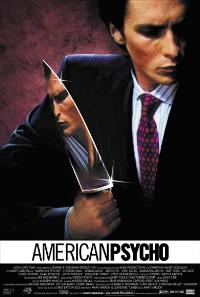
As I have mentioned before, American Psycho (Mary Harron, 2000) is one of my favorite films. It is smart, complex, beautiful and very much open to analysis and interpretation. Today's film is not.


American Psycho 2: All American Girl (Morgan J. Freeman, 2002) is a pseudo-sequel to the 2000 psychological thriller and has almost nothing to do with it. It is almost universally hated and has a Rotten Tomatoes score of 11%. Today, I will try to figure out why it is so hated and explain why I actually enjoy the film and has seen it three times.


The film is about Rachel Newman (Mila Kunis), who anonymously killed Patrick Bateman (unfortunately not portrayed by Christian Bale) when she was twelve years old. Now a freshman criminology student, she is dead set on getting to be the next T.A. for professor Robert Starkman (William Shatner), as most of his previous T.A:s have become FBI agents. She is obsessed with Starkman and kills her competitors for the position. Meanwhile, her psychiatrist Dr. Eric Daniels (Geraint Wyn Davies) becomes suspicious of her as he recognizes sociopathic and delusional traits in her.

A big part of the criticism aimed at the film is how little relation it has to American Psycho. Bateman's part in the story is very minor and they could have easily traded him in for any other serial killer without changing the plot. In fact, the original script for the film did not include Bateman as a character or plot point. Lions Gate Films, the production company, simply wanted to cash in on the critical and commercial success of the 2000 film. Therefore, I think the film would have been received more positively if they had stuck to the original script.

Before moving on to reviewing the film as a stand-alone product, I would like to discuss the ways in which American Psycho 2 suffers when compared to American Psycho. The 2000 film is very tightly linked to the 1980s and works as a critique of the very superficial aspects of the decade and a sequel could be expected to e.g. critique the nihilism of the 1990s in a similar way. American Psycho 2 could unfortunately be set in any time period after cars became commonplace. American Psycho is also very beautiful to look at. It is polished and very memorable because of the aesthetics alone. American Psycho 2, on the other hand, looks like any typical low-budget college slasher film and the set design adds nothing to the atmosphere of the film.

I have found it difficult to satisfyingly place the film in any particular genre. It is not scary enough to be a horror film and not suspenseful enough to be a thriller. It doesn't have enough gore to be a proper slasher and the jokes are not emphasized enough for a black comedy. It works as a strange blend of multiple genres and there is a noticeable shift after the first act. The first act sets up the film as a murder mystery, with one of Rachel's competitors as a suspect, but the red herring is revealed when she kills him early on. The rest of the film works like a female stalker film, but from the stalker's perspective. Normally in such a film the protagonist is the victim and not the stalker. This could be viewed as similar to American Psycho, where the reprehensible murderer is the protagonist. The audience is confused as to who they should root for and American Psycho 2 offers a sympathetic foil for Rachel in Dr. Daniels.

The weakest part of the film is undoubtedly the first act. Rachel's fellow college students are all cliched characters, portrayed by bad actors, and even Kunis doesn't give a particularly good performance. Luckily, it is fairly short and after a few murders the film focuses more on what works really well: the trinity of Rachel, Starkman and Dr. Daniels. Kunis shines as the manipulative and delusional Rachel in scenes with Shatner and Davies, surprisingly without channeling her Jackie-character from That '70s Show (1998-2006). The dark humor also becomes better when the audience no longer has to be lead to think that Rachel is innocent.

This is why I thoroughly enjoy the film. If you can look past the very misleading title and the weak first act, you'll probably like it as well.

onsdag 14 januari 2015

American Mary (2012): Rape and more Body Horror

I was not originally planning to discuss body horror further, at least not this soon after my review of Contracted (Eric England, 2013). Netflix had other plans. While looking for suggestions, I found another body horror film, also dealing with rape and the destructive and corrupting consequences of rape, but in a different way. For this review, I will discuss the plot in greater detail, so you may want to watch the film before reading any further.

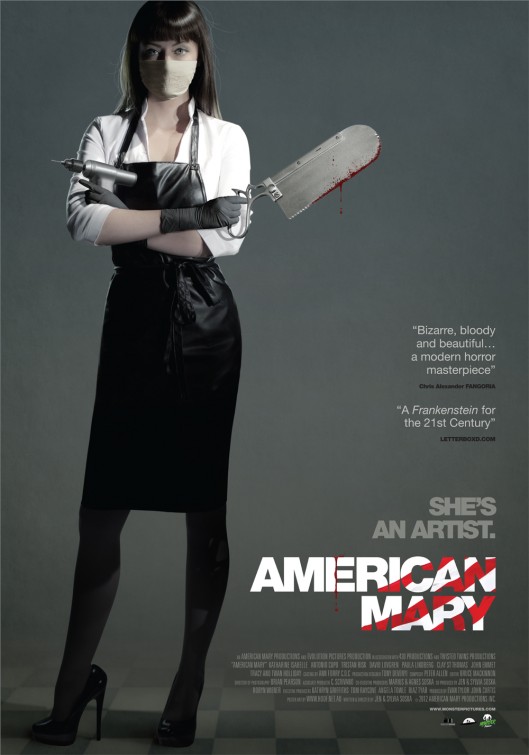
American Mary (Jane Soska & Sylvia Soska, 2012) is about Mary (Katharine Isabelle), a medical student whose financial troubles and excellent surgical skills result in her doing extreme body modification procedures. One notable client is Ruby (Paula Lindberg), a woman who wants to become a doll and asks Mary to remove her nipples and external genitalia. After she is drugged and raped by one of her teachers (David Lovgren), Mary drops out of medical school and starts doing body modifications full time. She also kidnaps her rapist and uses him "for practice", horribly disfiguring him. Her luxurious new life is threatened when an agent starts investigating his disappearance.


While Contracted attemps to show how rape affects the everyday life of the victim, American Mary focuses on how the victim deals with the consequences. When Mary is raped, she loses control over her body and she attempts to regain control by punishing her rapist and stripping him of control by stripping him of various body parts. She also helps others keep control over their bodies by modifying them according to their requests. When Mary asks Ruby (a pre-rape client) why she would want the requested procedure, she explains that dolls cannot be sexually objectified because they lack nipples and genitalia. Ruby wants to make her body her own, and not someone else's object. This feminist line of thought is continued later in the film when Ruby's husband beats her and wants revenge on Mary for taking away his sexual object.

The rape also changes Mary's moral outlook. She enjoys the sadistic punishment she continually inflicts on her rapist, which makes her increasingly less sympathetic to the audience. Even though we know that he is a serial rapist and has witnessed his brutal rape of Mary, the punishment cannot be justified because it is not redemtive for him, rather corruptive for her. Mary becomes a rapist by taking away his control over his body. Let's compare her revenge rape to that of Lisbeth Salander (Noomi Rapace) from The Girl With the Dragon Tattoo (Niels Arden Oplev, 2009). Lisbeth punishes her legal guardian Bjurman (Peter Andersson) for raping her by tattooing "I am a sadist pig and a rapist" on his chest and anally raping him with a dildo. She also blackmails him with a recording of her rape and demands that he leaves her alone. Lisbeth punishes by raping him back, branding him as a rapist to protect other women and releasing herself from his power, enabling her to move on with her life. Mary, on the other hand, does not move on and keeps her rapist as a pet for her to occasionally torture. Lisbeth allows Bjurman to live, with restrictions suitable for a violent sex offender, and checks up on him to make sure he behaves. He is basically on parole. Lisbeth's revenge is justified in motive and in method, while Mary's simply makes her worse. This is why Lisbeth's character is far more sympathetic than Mary's. One could of course argue that Mary's revenge is more satisfying as a fantasy. It is an expression of all her hate towards him and therefore does not have to be constructive, like Lisbeth's.

I have to mention that American Mary has a lot of unnecessary "male gaze" for a film about rape. As you can see from the trailer, Mary herself is often sexualized by the camera. There is, however, often a male character objectifying her in such scenes, allowing the audience to distance themselves from the shot. The rape scene is also decently done. It keeps focus on Mary's and her rapist's faces, alternating between her agony and his hateful lust.

The directors, known as the "Soska Sisters", are big fans of modern horror films and it definitely shows. Therefore I can only recommend this film to horror hound who aren't afraid of uncomfortable gore. Luckily, I am one of those and I really enjoyed it. Watch at your own risk!

torsdag 8 januari 2015

Contracted (2013) and Body Horror

Body horror is a sub-genre of horror fiction which uses our fear of our bodies changing or otherwise becoming alienated from us. Elements of body horror are often used in other types of horror films; in Alien (Ridley Scott, 1979) the titular monster lays its eggs inside its victims and the contemporary "torture porn" sub-genre, with films like Saw (James Wan, 2004) and Hostel (Eli Roth, 2005) and their sequels, wants the audience to fear what someone might do to their bodies. The films mentioned all have an element of someone or something external attacking the body, but today's review will focus on a film where the attack is coming from within. The Fly (David Cronenberg, 1986) and Cabin Fever (Eli Roth, 2002) are other films that use the same approach.

 
Contracted (Eric England, 2013) is about Samantha (Najarra Townsend), a young lesbian, who gets raped at a party and contracts a strange STD, which causes her body to, for lack of a better word, decompose. The transformation is slow and Samantha tries her best to hide the symptoms from her mother, friends, co-workers and her ex-girlfriend, with whom she tries to get back together.


Rape is a common theme in body horror, probably because it represents both violation and loss of control. In Alien, victims are inseminated through an act which could be described as a literal face rape. Samantha's rape in the beginning of Contracted is handled in an interesting way. While the audience sees how the rapist slips Rohypnol into her drink and how she begs him to stop during the act, Samantha seems unsure herself. She is also afraid to tell people, especially her ex-girlfriend who may view it as a drunken one night stand with a man, undermining her sexual identity. You could say that the film gives a realistic depiction of rape, showing both the act and the subsequent shame and fear of not being believed.
Samantha's character is the only remotely likable one in the film. Every other character either judges her harshly, wants to sleep with her or both. This is partially justified as the film focuses on Samantha's point-of-view and her being a rape survivor, this mirrors both her loss of faith in other people and other people's reactions towards her. However, her friends aren't particularly likable characters even before her rape. Additionally, as a result of her disease, Samantha becomes increasingly unlikable as the film progresses. She is still sympathetic, we truly feel sorry for her, but her actions become harder for us to understand and rationalize.

The film has been criticized as "punishing a lesbian for being raped", which I guess is arguably true. I would however rather interpret Contracted as telling the story of the tragic aftermath of a rape. Being raped and contracting a disease not only destroys Samatha's body, but also her relationships.

The film deserves praise for the way it handles a complex and sensitive subject and for Samantha's character development. It also did a great job with the practical special effects, showing Samantha's gruesome physical transformation. Other than that, Contracted is just okay. The ending is a bit predictable and doesn't really mix well with the rest of the film. Still, I think the film is definitely worth watching. It is far from perfect, but unlike most horror films featuring a literal rape it isn't a revenge story, which is kind of refreshing.

As a last note, I would like to comment on how stupid the title is. Why does almost every horror film nowadays have to have these vague one-word titles? Contracted might as well be the story of a contract killer!

torsdag 6 november 2014

Robin's Favorites: American Psycho (2000)

This review will be more analytical than my review of Ed Wood (Tim Burton, 1994). Therefore, I will have to discuss the plot in greater detail. Naturally, this means that if you haven't yet seen the film, I suggest you watch it before reading any further. Much of what I am about to discuss have already been discussed by others, but I hope I have something new to contribute.


American Psycho (Mary Harron, 2000) is a thriller with a large chunk of black comedy. The film is set in the 80s and is narrated by protagonist Patrick Bateman (Christian Bale), a Wall Street VP who moonlights as a serial killer. It is based on the eponymous novel by Bret Easton Ellis. Unfortunately I haven't yet read the novel, but I think the film can be meaningfully analyzed independently.


The film follows Bateman's life before, during and after he murders Paul Allen (Jared Leto), another Wall Street guy. He is engaged to Evelyn (Reese Witherspoon), a socialite who mostly cares about being socially correct and wants to marry Bateman for that reason. Bateman doesn't care about Evelyn and is having an affair with the drug-addicted Courtney (Samantha Mathis), who is engaged to his closeted homosexual colleague Luis (Matt Ross). Bateman is jealous of Allen's job and social status and kills him. As he tries to cover up the murder, Detective Donald Kimball (Willem Dafoe) starts investigating Allen's alleged disappearance. He has a nice assistant, Jean (Cloe Sevigny), who suspects that there is something strange about him. Throughout the film, Bateman murders numerous women and hires a prostitute (Cara Seymour), who he names "Christie".

All of the actors and actresses give splendid performances, but no one comes close to Bale. If they had chosen a lesser actor to portray Bateman, the film would have been a disaster. Bateman is the narrator and the focus of every single scene. Therefore, I think it would be impossible for me not to select his character as the focus of my analysis.

The film almost explicitly states that Bateman lacks identity. In one of the opening scenes, he says that while "there is an idea of a Patrick Bateman", he is "simply not there". This view is further supported by the fact that he does not mind being mistaken for someone else and that he often makes up names for the prostitutes he hires. He does not consider it important. When Bale portrays Bateman in social situations, he makes it clear that Bateman is acting and that every word he utters is insincere. He is simply trying to fit in by pretending to be like everyone else. His obsessive talk about popular music before acts of violence, could also be interpreted as trying to fit in.

While I accept this interpretation, I would also argue that there is a real Patrick Bateman, beyond the feelings of jealosy and greed that he admits experiencing. In the trailer above, Bateman attempts to partake in the very misogynistic conversation they are having about women. He tells an anecdote about a serial killer's views on women and finds it hilarious. He is, however, the only one. This is the real him. He is fascinated by murder and mayhem and this idea will be more intelligible later, in my discussion of the ending. Bale's performance clearly informs the audience when Bateman is acting and when he is sincere, and if there was no Bateman, this distinction should not be so easily identified.

One of Bateman's main character traits is his focus on appearances. In the beginning of the film, we are treated to most of his morning routine and a detailed narration of every single step. We also see him working out and tanning, all to keep himself fit and handsome. He is an expert on fashion and even uses a Jean Paul Gaultier bag when disposing of a body. He is also very much bothered by other people's fashion faux pas and is not above correcting them. This shallowness goes even further, for example in this famous scene where Bateman and his colleagues compare business cards:


It is important to note that all of their cards are very similar, white with black text, and that it seems unneccessary to put too much emphasis on their trivial differences. Bateman is distraught that Paul Allen has a nicer business card than he and along with the fact that Allen can get a reservation at Dorsia, this results in him killing Allen. Paul Allen can be viewed as Bateman's perfect self; he has a better job, better connections and, as is revealed after the murder, a nicer and more expensive apartment. He is arrogant and shallow, but more successful than Bateman. After murdering Allen, Bateman even pretends to be him when hiring prostitutes. Admiration turns to jealosy, turns to anger and finally violence. As Bateman axes Allen in the head, he screams "Try getting a reservation at Dorsia now you fucking stupid bastard!" Dorsia is the most popular restaurant in Manhattan and only the most well-connected people can get a reservation. Bateman cannot. Dorsia represents what Bateman lacks and he often tries, unsuccessfully, to get a reservation. He twice fakes getting a reservation; he first tricks a drugged Courtney that they are at Dorsia and later tells Jean that they are going to Dorsia for dinner, when he in fact plans to murder her at his apartment.

Bateman's sexuality is also debatable. While he has sex with multiple women in the film, he seems to take more pleasure from hurting them rather than from the sex. In one scene, when he has a threeway with two prostitutes, he even checks himself out in the mirror, flexing his muscles. Afterwards, he hurts them with a coat-hanger. Bateman could be viewed as a latent homosexual, which would explain his promiscuity as overcompensating, and his fear of his sexuality would explain his hatred of Luis, who even comes on to him. For more on this, see Rantasmo's review.

While Bateman mostly prefers to be alone, he does have one person that almost could be considered a friend: Timothy Bryce (Justin Theroux). Bryce is very similar to Bateman, but he is not considered a threat. Early in film, Bateman describes Bryce as "the most interesting person [he] know[s]" and the two of them are shown doing cocaine together in club bathroom, where Bryce confides in Bateman about the side-effects of his steroid use. In the business card scene, Bateman is bothered by the fact that Bryce prefers Allen's business card to his. This implies that he cares about Bryce's opinion and the fact that he never considers murdering Bryce, even though he knows that he is having an affair with Evelyn, shows that their relationship is different from his relationships to other colleagues.

Bateman also has a special relationship with his assistant Jean. Bateman invites her to his apartment planning to kill her, but after a message from Evelyn on his answering machine, revealing to Jean that he is still engaged, he changes his mind and tells her to leave or else she might get hurt. Jean thinks he is referring to emotional pain and leaves. My interpretation as to why he spared her revolves around their conversation before Evelyn's message. She is genuinely nice to him, which no other character seems to be, and tells him about her plans and dreams, which he insincerely asked about. Bateman sees his other victims as shallow, horrible people, much like he views himself, and when he notices that Jean is different, he no longer wants to kill her. Instead, he sends her away because he is afraid that his urges might force him to. She is also the first person he calls when he suffers a breakdown.

SPOILER ALERT: The following four paragraphs discuss the ending of the film.

In a twist ending, it is revealed that Paul Allen is alive and well. Bateman is given this information by his lawyer, who refers to him as Davis. Before this, Bateman went to dispose of Allen's corpse, but found that Allen's remains are nowhere to be found. He is confused and frustrated that his lawyer doesn't believe his confession, and concludes that while he has escaped righteous punishment for his crimes, he does not feel better and will continue to inflict his pain on others.

While Bateman still believes that he did all of the horrible things the film has shown us, we, on the other hand, are forced to conclude that Bateman is insane. This, while a bit unexpected, is not too hard to accept, since we have have seen him taking medication in moments of stress. Insanity would also explain some of the film's more unrealistic  scenes, such as him blowing up a police car by shooting it (which even surprised himself) and killing Christy in a stairwell by dropping a chainsaw on her from several floors up. In the end, Jean also finds disturbing drawings in his calendar, revealing his morbid fantasies.

The fact that he never killed Paul Allen has huge consequences for the rest of the film. Every scene in Allen's apartment or referencing his disappearance must be figments of his imagination. Whether or not he actually committed other murders is uncertain. This also implies that Detective Kimball never existed, since there was in fact nothing for him to investigate. This makes sense, considering that Kimball in one scene shows Bateman a Huey Lewis and the News CD, which Bateman had played during the murder. Kimball could be interpreted as Bateman's fear of being discovered for what he is (whatever that may be).

Through this, we may interpret Bateman's obsessive need to fit in and be normal not as a way of covering for his murders or latent homosexuality, but for his mental illness. He must focus his attention on his appearance, since he cannot deal with what lies beneath. Maybe he created his psychopath persona as an excuse for him to pretend that there is nothing inside him worth thinking about, that he simply isn't there.

There are many reasons why this is one of my favorites. For one thing, it is extremely memorable. There are three scenes where Bateman plays and talks about music and these will stick with you like Alex (Malcolm McDowell) singing "Singing in the Rain" before raping a woman in A Clockwork Orange (Stanley Kubrick, 1971). Whenever I hear "Hip to be Square", "Sussudio" or "The Greatest Love of All", I think of Paul Allen's murder, Bateman in a threeway and lesbian foreplay respectively.

The film has remained controversial for a number of reasons. One of the more profound accusations have been misogyny. I will not deny that there is a lot of violence against women in the film and that nearly every female character is weak or timid. This film was definitely not made with a female audience in mind (excluding Bale's handsomeness and many nude or partially nude scenes). In its defense, the misogynist Bateman is not meant to be sympathized with. No one is supposed to view him as any kind of role model. That being said, I would not go so far as to suggest that the film uses misogyny as a way to critique misogynistic societal norms or conventions. Personally, I think some scenes go too far, but I can forgive them in the context of the rest of the film.

My main reason for loving this film can be seen on this page. There is just so much to think and talk about (and I haven't even mentioned the most common interpretation: as a critique of the shallowness of the 1980s) and as you should have realized by now, that is what I love to do.